


Operates normally even at -70°C! Groundbreaking breakthrough achieved in core lithium-battery technology.
2026/04/07
According to Li Yong, a researcher at Institute 811, this groundbreaking research achievement enables lithium batteries to achieve an energy density of over 700 watt-hours per kilogram at room temperature and still maintain approximately 400 watt-hours per kilogram even at −50°C.
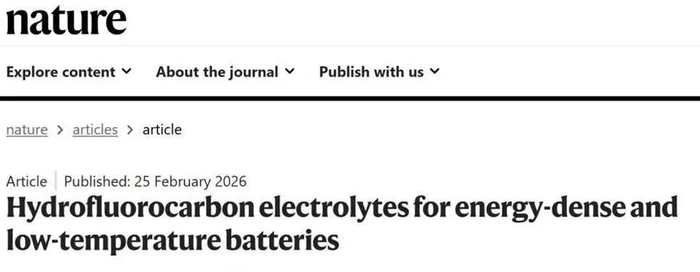
According to Shanghai Aerospace, a team comprising researchers from Institute 811, which is affiliated with the Eighth Academy of China Aerospace Science and Technology Corporation, and Nankai University has recently published a groundbreaking achievement in the international academic journal Nature: the successful development of a hydrofluorocarbon electrolyte for high-energy-density and low-temperature batteries. This milestone marks a new breakthrough in China’s core lithium-battery technologies and holds the promise of doubling the driving range of existing lithium batteries while significantly enhancing their low-temperature performance.
According to Li Yong, a researcher at Institute 811, lithium-ion batteries currently on the market have an energy density of about 300 watt-hours per kilogram at room temperature. However, at −20°C, their energy density drops sharply to below 150 watt-hours per kilogram. In contrast, this groundbreaking research achievement enables lithium-ion batteries to achieve an energy density exceeding 700 watt-hours per kilogram at room temperature and still maintain approximately 400 watt-hours per kilogram even at −50°C.
“Simply put, for a battery of the same mass, lithium batteries can boost energy storage capacity by more than two to three times at room temperature, thereby increasing the driving range of electric vehicles from 500–600 kilometers to 1,000 kilometers or even beyond—and they can still operate normally in extreme low temperatures as low as –70°C,” said Li Yong.
As a critical component that connects the positive and negative electrodes of a lithium battery, the electrolyte serves to conduct ions within the cell—acting like a “highway” between the electrodes—and plays a pivotal role in determining the battery’s energy efficiency, operational stability, and thermal adaptability.
Traditional electrolyte solvents have predominantly featured oxygen- (O-) and nitrogen-based (N-) ligands. While these solvents exhibit strong solubility for lithium salts, they also impede charge transfer, thereby limiting further improvements in lithium-battery energy density and degrading low-temperature performance.
Researchers turned their attention to fluorine, which shares the same period as oxygen, and after years of intensive technical攻关, they developed a new paradigm for high-performance electrolyte research: they overcame the longstanding challenge that fluorine (F) cannot dissolve lithium salts, and synthesized a novel electrolyte solvent containing monofluoroalkanes. This solvent effectively reduces electrolyte viscosity, enhances oxidative stability and low-temperature ionic conductivity, thereby improving the low-temperature energy output performance of high-energy-density lithium batteries. In this study, Institute 811 primarily undertook core research tasks such as electrolyte optimization, forward design of high-specific-energy battery cells, optimization of interfacial dynamic processes, and validation of performance under actual operating conditions, fully demonstrating its robust capabilities and leading position in the field of cutting-edge power-source technologies.
The breakthroughs of this research extend far beyond the laboratory, and their broad application prospects paint a new future for the energy transition.
In the field of high and new technologies, it can provide spacecraft and other equipment with more reliable power supply in the extreme cold of deep space, while also extending the endurance and increasing the payload capacity of drones and various types of intelligent robots. In everyday life, it will remove key barriers to the next generation of electric vehicles and smartphone batteries, potentially delivering a qualitative leap in electric-vehicle range and smartphone standby time in low-temperature environments, thereby resolving the “energy-storage-capacity anxiety” and “temperature-adaptation anxiety” that have long plagued battery technology and opening up limitless possibilities for a higher-energy, safer energy future.
Flash Technology

Copyright @ 2022 Taizhou Flash Technology Co., Ltd. All Rights Resserved. Powered by www.300.cn


